


The chart looks dense at first. These six things are all you need to read it.

Our first and lasting impression is one of being simply mesmerized. It is larger and heavier than expected, but the size speaks to its content. Far and away our most coveted purchase.
Buddy, verified buyer

My husband and I have poured over it a few times now, and every time there is something new to discover. I didn't realise how incredibly big it is. We needed the entire length of our living room.
Christine T., verified buyer
Adam's Synchronological Chart or Map of History
Adam's Synchronological Chart or Map of History
Regular price
$49.00 USD
Regular price
Sale price
$49.00 USD
Unit price
per
Shipping calculated at checkout.
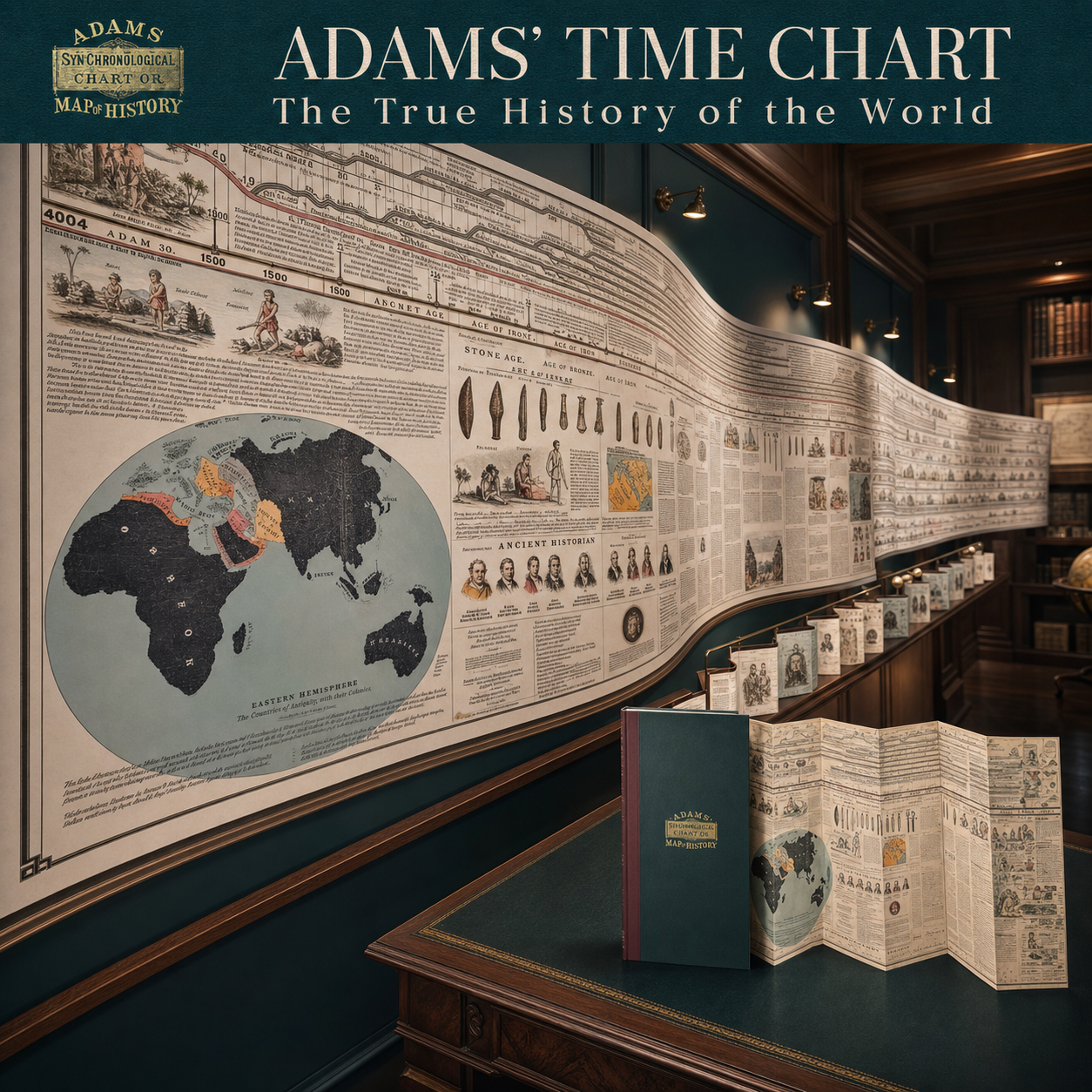
A 23-foot fold-out timeline of world and biblical history, first drawn by Sebastian Adams in 1871. Twenty-one hand-illustrated panels run from creation to 1870 in one unbroken line. Read it a panel at a time, or open it right across the room.
Description
Description
Most history books hand you one thread at a time. Egypt in chapter three, Rome in chapter seven, and no real sense of what was happening in China while Caesar crossed the Rubicon.
Adams' Synchronological Chart or Map of History puts all of it side by side. Nations and kingdoms run as coloured streams down the page. A black wavy line carries the years, divided by pillars every century and red lines every decade. Pick any date, look straight down the panel, and you see the whole world at that moment.
What you get
- 21 full-colour panels, hand-glued onto 12pt deluxe matte cardstock
- 23 feet long by 27 inches tall when fully opened
- Creation at 4004 BC through to 1870 and the 19th US President, R.B. Hayes
- Life lines for significant people, flags for major battles, scrolls for poets and historians, crosses and circles for events in Christian history
- Handwritten commentary and full-colour drawings throughout
- Hardcover case, so it folds shut and stores flat on a shelf
What they said about it
"It is worth a library of books on the subject of history."
G. McCloskie, LL.D., Professor of Natural History, Princeton College
"Indicates at a glance the date, progress, and synchronism of historical events, as clearly as could be learned in days and weeks in ordinary historical works."
A.D. Hager, Secretary, Chicago Historical Society
"The plan adopted is a very ingenious one, such that the student sees at a glance exactly the condition of the world at any given date."
Scientific American
Who it's for
Homeschool families, history teachers, Bible students, and anyone who has wanted to see how the pieces fit together. Based on the chronology in James Ussher's The Annals of the World. Suits roughly grade 5 through adult.
4.8★ from 2,757 ratings
Couldn't load pickup availability
First published 1871 ● Reproduced in full colour
Our Happy Readers


What's Included?
What's Included?
- The chart: 21 full-colour fold-out panels, hand-glued and bound into a hardcover case. 23 feet by 27 inches opened, roughly 13 x 27 inches closed.
- The case: a hard cover that protects the panels and lets the whole thing sit flat on a shelf between readings.
Who Is It For?
Who Is It For?
Homeschool families, classroom teachers, Bible study groups, and anyone who likes history but has never been able to hold the shape of it in their head. No background needed. Children tend to go straight for the drawings, and the dates follow on their own.
It also makes a serious gift. This is the kind of book people keep and pass down.
Shipping & Delivery
Shipping & Delivery
Orders ship with tracking and most arrive within a few business days. The chart is heavy and boxed flat to protect the fold-out panels, so it travels well.
Our first and lasting impression is one of being simply mesmerized. It is larger and heavier than expected, but the size speaks to its content. Far and away our most coveted purchase.
Buddy, verified buyer
My husband and I have poured over it a few times now, and every time there is something new to discover. I didn't realise how incredibly big it is. We needed the entire length of our living room.
Christine T., verified buyer


View all products


How to Read 6,000 Years
No prior history needed
1
Open a Panel
Start at the top and work down. Each panel covers its own slice of time.
2
Follow the Streams
The wide coloured bands are nations and kingdoms. Each ruler gets a colour of their own.
3
Read the Time Line
The black wavy line carries the years. Pillars mark centuries, red lines mark decades.
4
Spot the Symbols
Flags are major battles. Scrolls are poets, historians, and literary works. Crosses and circles mark Christian history.
5
Look Straight Down
Everything on the same vertical line happened at the same time. That is the whole idea.
6
Open It Fully, Once
Twenty-three feet needs a hallway or a long wall. Worth doing at least once.
First Published 1871
A reference you keep for decades.
Built to Last
Hand-glued 12pt deluxe matte cardstock.
Hardcover Case
Protects the panels and stores flat on a shelf.

Table or Wall
Open a few panels at a time, or run the whole length.
Teach From It
The 64-page key covers each region in turn.

Built to Last
Hand-glued 12pt deluxe matte cardstock.
Hardcover Case
Protects the panels and stores flat on a shelf.
Table or Wall
Open a few panels at a time, or run the whole length.
Teach From It
The 64-page key covers each region in turn.

Why a Chart Beats a Chapter
Dates are easy enough to memorise and hard to feel. Seeing them side by side changes that.

ADAMS' CHART
- The whole world on one line
- See what was happening at the same time
- Open it on the floor with your kids
- One purchase, used for years
- Illustrations you stop and look at
A SHELF OF HISTORY BOOKS
- One civilisation per volume
- Piece the dates together yourself
- Read it alone, chapter by chapter
- A new book for every era
- Walls of text and a few maps
VS
23 feet long by 27 inches tall fully opened. Closed it is a hardcover roughly 13 by 27 inches and under an inch thick. Most people open a few panels at a time on a table, then run the full length down a hallway once for the fun of it.
Creation at 4004 BC through to 1870, ending with the 19th US President, R.B. Hayes. It follows the chronology in James Ussher's The Annals of the World.
It is built for it. The chart suits roughly grade 5 through adult, working through the regions one at a time. Younger children tend to go for the drawings first and pick up the dates from there.
This is the hardcover edition, built to fold and store as a book, so it is best displayed open along a shelf, table, or ledge.
Frequently Asked Questions
Buy Now