


Seven chapters, in the order you'll reach for them.

Well written and straight to the point. I am a new grad and this book was so insightful. I will definitely be rereading this book to keep my charting skills tip top.
Monique Alexander

Very informative. Thank you for this great book!
Bella

I was looking for a guide on charting as a new grad nurse an this is it. If you don't have it get it now!
Jacob
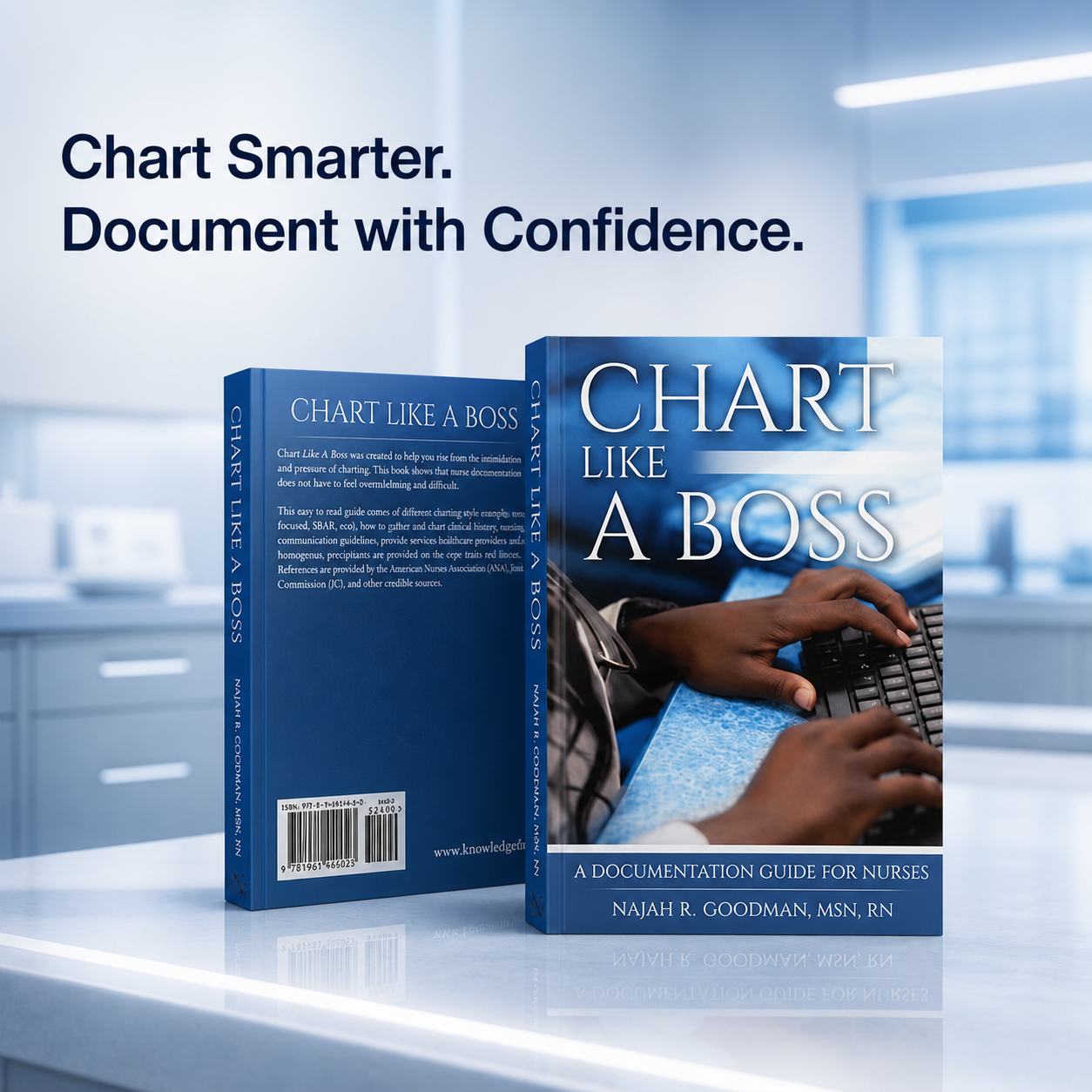
Chart Like a Boss: A Documentation Guide for Nurses
Chart Like a Boss: A Documentation Guide for Nurses
A charting handbook for nurses, written by a nurse. Charting styles, head-to-toe assessments, more than 900 medical abbreviations and real nursing note examples you can adapt on shift. 151-page paperback.
Description
Description
Chart Like a Boss was written to take the intimidation out of charting. Nurse documentation does not have to feel overwhelming.
The guide works through the main charting styles (narrative, focused, SBAR), how to gather and chart a clinical history, and how to communicate with providers and colleagues inside the chart. Nursing tips and advice run throughout. References come from the American Nurses Association and the Joint Commission.
Written for new grad nurses. Useful to seasoned ones.
151 pages ● 900+ abbreviations A–Z
Couldn't load pickup availability
Paperback ● 151 pages ● Includes The Charting Toolkit (free PDF)
What's Included?
What's Included?
One paperback, seven chapters, 151 pages:
- Communication: talking to providers and colleagues in the chart.
- When to Chart: timing, and what has to be written down immediately.
- The Basics: narrative, focused and SBAR, and where each fits.
- Charting Do's and Don'ts: the habits that hold up under review.
- Clinical History: chief complaint, HPI, head-to-toe and review of systems.
- Medical Abbreviation: 900+ abbreviations A–Z plus the Joint Commission Do Not Use list.
- Nursing Note Example: worked notes you can adapt on shift.
Plus, free with every copy: The Charting Toolkit, a 15-page printable PDF with 30 nursing note templates, the Joint Commission Do Not Use badge card, a head-to-toe checklist, and a five-minute end-of-shift chart check.
Who Is It For?
Who Is It For?
New grad nurses who know the clinical work but freeze at the keyboard, and nursing students who want to start with good habits. It assumes you have the clinical knowledge and focuses on getting it into the chart.
Seasoned nurses use it as a reference: the abbreviations list and the note examples are the pages that stay open. It also makes a straightforward gift for someone starting their first ward job.
Shipping & Delivery
Shipping & Delivery
Paperback: all orders ship with tracking. Orders are processed within 1–3 business days. Delivery: US 7–18 business days.
Well written and straight to the point. I am a new grad and this book was so insightful. I will definitely be rereading this book to keep my charting skills tip top.
Monique Alexander
Very informative. Thank you for this great book!
Bella
I was looking for a guide on charting as a new grad nurse an this is it. If you don't have it get it now!
Jacob




Included free: The Charting Toolkit
Every copy comes with a 15-page printable PDF, sent to you after checkout.
- The Exact Words — 30 nursing note templates for the moments that get read back to you: refusals, AMA, falls, pain reassessment, chain of command, wounds, medication events, change in condition, admission and discharge.
- The Do Not Use List — the Joint Commission's official list, with a cut-out badge card.
- Head-to-Toe Checklist — a full assessment prompt list for fast shifts.
- The 5-Minute Chart Check — six steps to run before you clock out.

What's Actually Inside
From first handover to final note
1
Communication
How to talk to providers and colleagues inside the chart, including SBAR.
2
When to Chart
Timing, late entries, and what has to be documented the moment it happens.
3
The Basics
Narrative, focused and SBAR charting, and where each one actually fits.
4
Do's and Don'ts
The habits that hold up under review, and the ones that get a note questioned.
5
Clinical History
Chief complaint, history of presenting illness, head-to-toe and review of systems.
6
Abbreviations & Notes
900+ abbreviations A–Z, the Do Not Use list, and worked note examples.
A Documentation Guide for Nurses
Built for the middle of a shift.
Quick to Search
Abbreviations run A–Z, so you find one fast.
Worked Examples
Real nursing notes, not blank templates.

Fits Your Bag
5 x 8 inches, 151 pages, softcover.
Real Sources
Referenced to the ANA and the Joint Commission.

Quick to Search
Abbreviations run A–Z, so you find one fast.
Worked Examples
Real nursing notes, not blank templates.
Fits Your Bag
5 x 8 inches, 151 pages, softcover.
Real Sources
Referenced to the ANA and the Joint Commission.
Why a Handbook Beats Googling It
Charting questions come up mid-shift, when you have no time to search and no business being on your phone at the desk.

THIS HANDBOOK
- 900+ abbreviations in one A–Z list
- Note examples you can adapt on the spot
- Referenced to the ANA and Joint Commission
- The Do Not Use list in your hand
- Works with no signal and no login
GUESSING
- A different search result every time
- Rewriting the note from scratch
- A forum post from 2014
- Hoping the abbreviation is accepted
- A phone you shouldn't be on at the desk
VS
New grad nurses who know the clinical work but freeze at the keyboard, nursing students, and experienced nurses who want their documentation tighter. It assumes you have the clinical knowledge and focuses on getting it into the chart.
A 15-page printable PDF included with every copy, emailed after checkout. It holds 30 nursing note templates for high-risk moments, the Joint Commission Do Not Use list as a cut-out badge card, a head-to-toe assessment checklist, and a five-minute chart check to run before you clock out. It's educational material, not legal advice — your facility's policy always comes first.
Seven chapters across 151 pages: communication, when to chart, charting basics, do's and don'ts, clinical history, more than 900 medical abbreviations A–Z, and worked nursing note examples.
A reference you read once and then keep. Chapters one to five read straight through. The abbreviations list and the note examples are what you come back to.
Narrative, focused and SBAR, plus guidance on communicating with providers and colleagues inside the chart.
The paperback edition, 151 pages, 5 x 8 inches
Frequently Asked Questions
Buy Now